
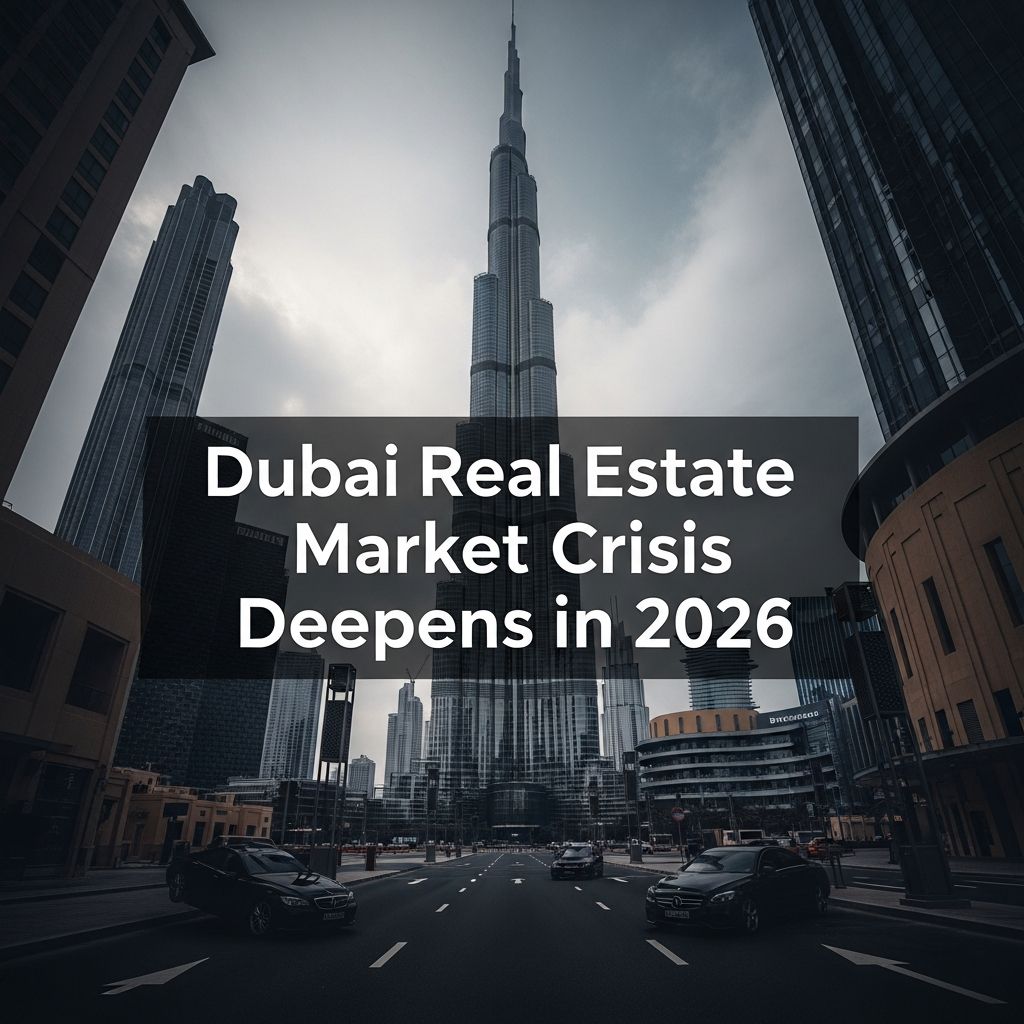
Dubai Real Estate Market Faces Unprecedented Crisis in 2026: The Devastating Impact of Regional Warfare
The once-glittering Dubai real estate market is experiencing its darkest chapter in recent history. What began as isolated concerns about regional tensions has evolved into a full-scale market crisis that threatens to unravel decades of growth and development. The ongoing conflict between Iran, the USA, and Israel has triggered a confluence of economic uncertainty, investor panic, and market instability, fundamentally transforming Dubai’s property landscape.
Despite attracting billions in investment over the past decade, the Dubai real estate market is no longer the safe haven it once seemed to be. The geopolitical turmoil has exposed underlying vulnerabilities that many investors chose to ignore during the boom years. Now, as missiles fly and diplomatic relations deteriorate, the true cost of investing in a region surrounded by conflict is becoming painfully clear.
The market correction we’re witnessing isn’t just a temporary adjustment—it’s a fundamental shift that signals the end of Dubai’s property market as we knew it. The numbers are unmistakable, depicting a systematic decline that shows no indications of abating.
The Geopolitical Storm: How Regional Warfare Shattered Market Confidence
The escalation of tensions between Iran, the USA, and Israel has created an environment of perpetual uncertainty that is toxic to real estate investment. Unlike previous regional conflicts that remained relatively contained, this crisis has directly threatened Dubai’s position as a neutral business hub, forcing investors to confront the reality that no market in the Middle East is truly insulated from regional warfare.
The Dubai real estate market has always depended on its reputation as a stable, politically neutral destination. That reputation is now in tatters. International investors are rapidly reassessing their positions, having once viewed Dubai as a safe alternative to more volatile regional markets. Investors lose confidence in a market’s fundamental stability, making recovery exponentially more difficult.
Financial institutions have responded predictably to the increased risk profile. Major international banks have quietly begun reducing their exposure to Dubai real estate loans, while insurance companies have dramatically increased premiums for properties in the region. This institutional retreat is creating a liquidity crisis that is strangling the market’s ability to function normally.
The timing couldn’t be worse. Dubai’s economy was already showing signs of strain from global economic headwinds, and the property market was beginning to show cracks from oversupply in certain segments. The geopolitical crisis has accelerated these underlying problems, turning manageable challenges into existential threats to market stability.
Dubai Real Estate Prices Plummet Across All Segments
The most visible impact of the crisis has been the dramatic decline in Dubai real estate prices across virtually every market segment. What started as modest corrections in luxury properties has spread throughout the market like a contagion, affecting everything from studio apartments to commercial real estate.
Luxury properties, once the pinnacle of Dubai’s real estate market, have faced a particularly severe impact. Prime waterfront developments that commanded premium prices just two years ago are now struggling to find buyers at any price. The ultra-high-net-worth individuals who drove demand in this segment have largely disappeared, either liquidating their holdings or postponing planned purchases indefinitely.
The mid-market segment, which many considered more resilient, is experiencing equally severe pressure. Dubai real estate prices in established areas like Dubai Marina and Jumeirah Lake Towers have fallen by 15-25% from their recent peaks, with no signs of stabilisation. Properties that took months to sell are now sitting on the market for extended periods, forcing sellers to accept increasingly desperate price reductions.
Even the affordable housing segment, traditionally more stable during market downturns, is showing signs of distress. Tightening credit conditions and economic uncertainty are pricing out first-time buyers who might have provided a floor for the market. The result is a market where sellers outnumber buyers by increasingly wide margins, creating a downward spiral in pricing that feeds on itself.
The carnage has also affected commercial real estate. Office buildings that once commanded premium rents are offering significant concessions to retain tenants, while retail properties are struggling with vacancy rates that would have been unthinkable just a few years ago. The Dubai property market’s commercial segment is particularly vulnerable because it depends heavily on international businesses that are now questioning their regional strategies.
Dubai Real Estate Appreciation Turns Negative Across the Board
The current market environment has rendered the concept of Dubai real estate appreciation nonsensical. Properties that were purchased as recently as 2023 are now worth significantly less than their purchase price, creating a generation of underwater investors who are trapped in positions they cannot exit profitably.
The rapid decline has taken many investors by surprise. Properties that historically appreciated at 5-8% annually are now depreciating at similar rates, representing a swing of more than 10 percentage points in total returns. This dramatic reversal has destroyed the fundamental investment thesis that attracted capital to Dubai’s property market in the first place.
Long-term investors who weathered previous market cycles are finding that this downturn is different. Typically, Dubai’s growth story remained intact, leading to relatively quick recoveries following previous corrections. This time, simultaneous compromises have undermined the underlying drivers of demand—political stability, economic growth, and international confidence.
Distressed investors’ forced selling is intensifying the negative appreciation trend. As property values decline, leveraged investors are facing margin calls and covenant breaches that force them to liquidate positions at precisely the worst time. This distressed selling creates additional downward pressure on prices, accelerating the negative appreciation cycle.
Perhaps most concerning is that the negative appreciation trend shows no signs of bottoming out. Traditional indicators that might signal a market floor—such as improved affordability ratios or increased transaction volumes—are nowhere to be seen. Instead, the market appears to be free-falling, with no clear catalyst for stabilisation.
Investor Confidence Collapses as Capital Flees the Market
The collapse in investor confidence represents perhaps the most serious long-term threat to Dubai’s real estate market. Confidence, once lost, is extraordinarily difficult to rebuild, especially in a market that depends so heavily on international capital and investor sentiment.
International investors, once eager to diversify into Dubai real estate, are now actively reducing their investments. Sovereign wealth funds that previously allocated significant capital to Dubai properties are redirecting investments to markets perceived as more stable. Private equity firms that specialise in Middle Eastern real estate are struggling to raise new funds as limited partners question the region’s investment prospects.
The exodus of capital is creating a vicious cycle. As international investors withdraw, the market becomes increasingly dependent on local demand, which is insufficient to support current price levels. This forces further price declines, which in turn drive away additional investors, perpetuating the downward spiral.
Retail investors, who provided crucial support during previous market cycles, are also abandoning the market. The combination of declining values, reduced rental yields, and increased carrying costs has made Dubai real estate an unattractive investment proposition for all but the most speculative investors.
The psychological impact extends beyond immediate market participants. The current crisis is permanently damaging Dubai’s reputation as a global investment destination. Even when the immediate geopolitical tensions subside, the market will face the challenge of rebuilding trust with investors who have been burnt by the current downturn.
Financing Crisis Strangles Market Liquidity
The tightening of credit conditions has created a financing crisis that is strangling market liquidity and accelerating the decline in Dubai real estate prices. Banks that were once eager to finance property purchases are now implementing increasingly restrictive lending criteria that effectively shut out many potential buyers.
Loan-to-value ratios have been slashed across the board, with many lenders now requiring downpayments of 40–50% for investment properties. This dramatic increase in equity requirements has eliminated a large portion of the potential buyer pool, particularly among international investors who relied on leverage to enhance their returns.
Interest rates on property loans have increased substantially, reflecting both global monetary tightening and increased risk premiums for Dubai real estate. The combination of higher rates and larger down payment requirements has made property investment financially unviable for many investors who were active in the market just two years ago.
The credit crunch is particularly severe for developers, who are finding it increasingly difficult to secure construction financing for new projects. Developers have struggled to arrange adequate funding, leading to the delay or cancellation of several high-profile developments. The financial crisis is creating additional uncertainty about future supply, which paradoxically is making the current oversupply problem worse as buyers delay purchases in anticipation of better deals.
International banks, which provided crucial liquidity to the Dubai property market during its growth phase, are retreating rapidly. Several major institutions have closed their Dubai real estate lending operations entirely, while others have dramatically reduced their appetite for new loans. This institutional retreat is creating a liquidity vacuum that local banks cannot fill.
Dubai Property Market Shows Signs of Complete Breakdown
The Dubai property market is exhibiting signs of systematic breakdown that go beyond normal cyclical corrections. Market mechanisms that typically provide stability during downturns are failing to function properly, creating conditions that resemble a market in free fall rather than an orderly adjustment.
Transaction volumes have collapsed to levels not seen since the 2008 financial crisis. Properties that would normally attract multiple offers are struggling to generate any serious interest from buyers. Few transactions occur, and those are increasingly distressed sales that differ significantly from normal market activity.
The rental market, which traditionally provided some stability during sales market downturns, is also showing signs of severe stress. Vacancy rates are climbing rapidly as tenants downsize or relocate to more affordable markets. Rental yields, once a key attraction for investors, have declined to levels that barely cover carrying costs, let alone provide attractive returns.
Market infrastructure is beginning to break down as well. Real estate agencies are closing offices and laying off staff as transaction volumes plummet. Property management companies are struggling with increased vacancy rates and declining rental collections. Even basic market services like property valuation and legal support are becoming pricier and harder to obtain.
The breakdown extends to market psychology as well. Fear and pessimism have replaced the optimism and confidence that characterised Dubai’s property market during its growth phase. Market participants are increasingly making irrational decisions based on emotions rather than analysis, as sellers panic and buyers become paralysed.
Long-term Consequences: A Market Forever Changed
The current crisis is not just a temporary setback—it represents a fundamental shift that will permanently alter the character of Dubai’s real estate market. The easy money and speculative fervour that drove the market’s growth over the past decade are unlikely to return, even after immediate geopolitical tensions subside.
The crisis has irreparably damaged Dubai’s reputation as a safe haven for international capital. The current crisis has shown that regional conflicts can still affect the emirate, highlighting the real and present danger of political risk for property investors. This realisation will permanently increase the risk premium that investors demand for Dubai real estate, leaving prices depressed even after market conditions stabilise.
The demographic trends that supported Dubai’s property market are also shifting in negative directions. The expatriate population that drove rental demand is beginning to decline as companies relocate operations to more stable regions. The high-net-worth individuals who purchased luxury properties are diversifying away from Middle Eastern assets, reducing demand in the market’s most profitable segment.
Regulatory responses to the crisis are likely to create additional headwinds for the market. Increased scrutiny of foreign investment, tighter lending standards, and enhanced reporting requirements will make Dubai real estate investment more complex and expensive, further reducing its attractiveness to international capital.
The development pipeline, once a source of optimism about Dubai’s growth prospects, has become a liability. Over the next few years, thousands of units scheduled for completion will join an already oversupplied and declining market. This supply overhang will suppress prices for years to come, preventing any meaningful recovery in property values.
The Verdict: A Market in Terminal Decline
The evidence is overwhelming—Dubai’s real estate market is experiencing a crisis of unprecedented severity that shows no signs of abating. Geopolitical instability, collapsing investor confidence, tightening credit conditions, and systematic market breakdown have created toxic conditions for property investment.
The Dubai real estate market that once attracted billions in international capital no longer exists. There is a distressed market, marked by declining prices, disappearing liquidity, and pervasive pessimism. The geopolitical crisis has intensified underlying issues and introduced fresh challenges that may require years to address, assuming any resolution at all.
For investors currently holding Dubai real estate, the outlook is bleak. Properties purchased recently are likely to remain underwater for the foreseeable future, while rental yields will continue to decline as vacancy rates increase. The carrying costs of ownership—including maintenance, insurance, and financing—will increasingly exceed the economic benefits of property ownership.
The broader implications extend far beyond individual investors. Dubai’s economy, which became increasingly dependent on real estate investment and development, faces a prolonged period of adjustment as this crucial sector contracts. The ripple effects will be felt throughout the emirate’s economy, from construction and finance to retail and hospitality.
We are witnessing the end of an era in Dubai real estate. The market now serves as a warning about the risks of investing in politically unstable regions, having once symbolically represented the emirate’s ambitions and garnered global attention. Not only has the Iran-USA-Israel conflict damaged Dubai’s property market, but it has also fundamentally altered its trajectory, and its effects will last for decades to come.
The wise investors have already departed. Those who remain are either trapped by circumstance or blinded by misplaced optimism about a recovery that shows no signs of materialising. The Dubai real estate market of 2026 is not experiencing a correction—it is experiencing a collapse.